
Why Reading the Declaration of Independence Matters
A Protest and Change in Venue; Philbrick's American Revolution Trilogy Required Reading as we Celebrate 250 Years

The sun rose at 5:08 this morning and will set at 8:08 this evening. We will be experiencing the longest days of the year these next four weeks as we roll towards the Summer Solstice on June 24. On that day we will have 15 hours and 9 minutes of daylight.
What does that mean to me? Long days in the garden before the film festival opens, June 17-21 this year. Then my days and nights will be spent in the Dreamland.
The Fourth of July is about six weeks away. When I was a kid, it was a day of pure fun. We didn’t have a grasp on the idea of patriotism but it seeped into us by osmosis. Those days are gone forever and politics seems to have marred the innocent joy of youth.
Where to Hear the Reading of the Constitution July 4th
The folks at the Unitarian Church have decided they will set aside their traditional reading of the Declaration of Independence this year, in protest to the folks in Washington, D.C., who these days treat those sacred words, and the Constitution especially the Bill of Rights, as if they were suggestions.
Traditionally, the Unitarian Church on Orange Street has organized and hosted the reading. It’s always been a packed event. But last Thursday that church’s spiritual leader, Rev. Erin Splaine, released a statement on Facebook that the reading would be cancelled this year in recognition of recent Supreme Court decisions that have gutted the 1965 Civil Rights voting act.
Celebrating the Declaration of Independence, the Constitution and the Bill of Rights at a time when civil liberties are being stripped from Americans felt wrong, said Splaine. We had discussions about that decision around the kitchen table that evening.
It is a well-meaning protest. But when the current administration seems intent on tearing down democracy, isn’t it more important than ever to read that document? Isn’t it essential to remind ourselves what our Founding Fathers envisioned 250 years ago?
And then there is this: For a long time now one political party, which is no more or less patriotic than the other political party, claimed the flag. Lapel pins became de rigueur on the right, while Democrats seemed bewildered. Let us make sure they do not claim the founding document as well.
Not reading the Declaration of Independence might make a small group of people feel as if they are taking an ethical stand, but it would be better to remind people of why we are free to take that stand. We the people is an idea that still carries power and promise. Father Max from St. Paul’s Episcopal Church announced early this week that the reading of the Declaration of Independence will take place at his church on Fair Street on the Fourth of July. No time has yet been set for the reading.
I understand the reasoning behind the Unitarian Church’s decision not to hold the public reading this year. That church is grounded in social justice and has done a lot in our island community to promote the rights of individuals. And, over the last 16 months a lot of Americans have been disenfranchised while the tenets of the Constitution have been ignored. I just think that by reading the Declaration of Independence there is an opportunity to remind people what this country stands for. It is a reflective moment.
My question is this: Looking ahead, in 2027 and beyond, why doesn’t the Town of Nantucket’s department of Culture and Tourism, wrap the reading of the Declaration of Independence into its Fourth of July activities? It could ask one of the big churches to host the event free of charge, but the town would organize the event and staff the building.
Clearly, from the feedback I’ve heard around town and seen posted on social media, reading that document on the Fourth of July is something residents and visitors value, as the Unitarian church is usually packed for this event.
Philbrick’s American Revolution Trilogy Must Reads
I began thinking about our country’s upcoming 250th anniversary last November, during the airing of Ken Burns’ six-part series on the American Revolution on PBS. We watched it every night.
What I remember most about the series was the continuous thread of appearances by Nantucket author Nat Philbrick who penned the first volume of his trilogy on the American Revolution, “Bunker Hill,” in 2013.
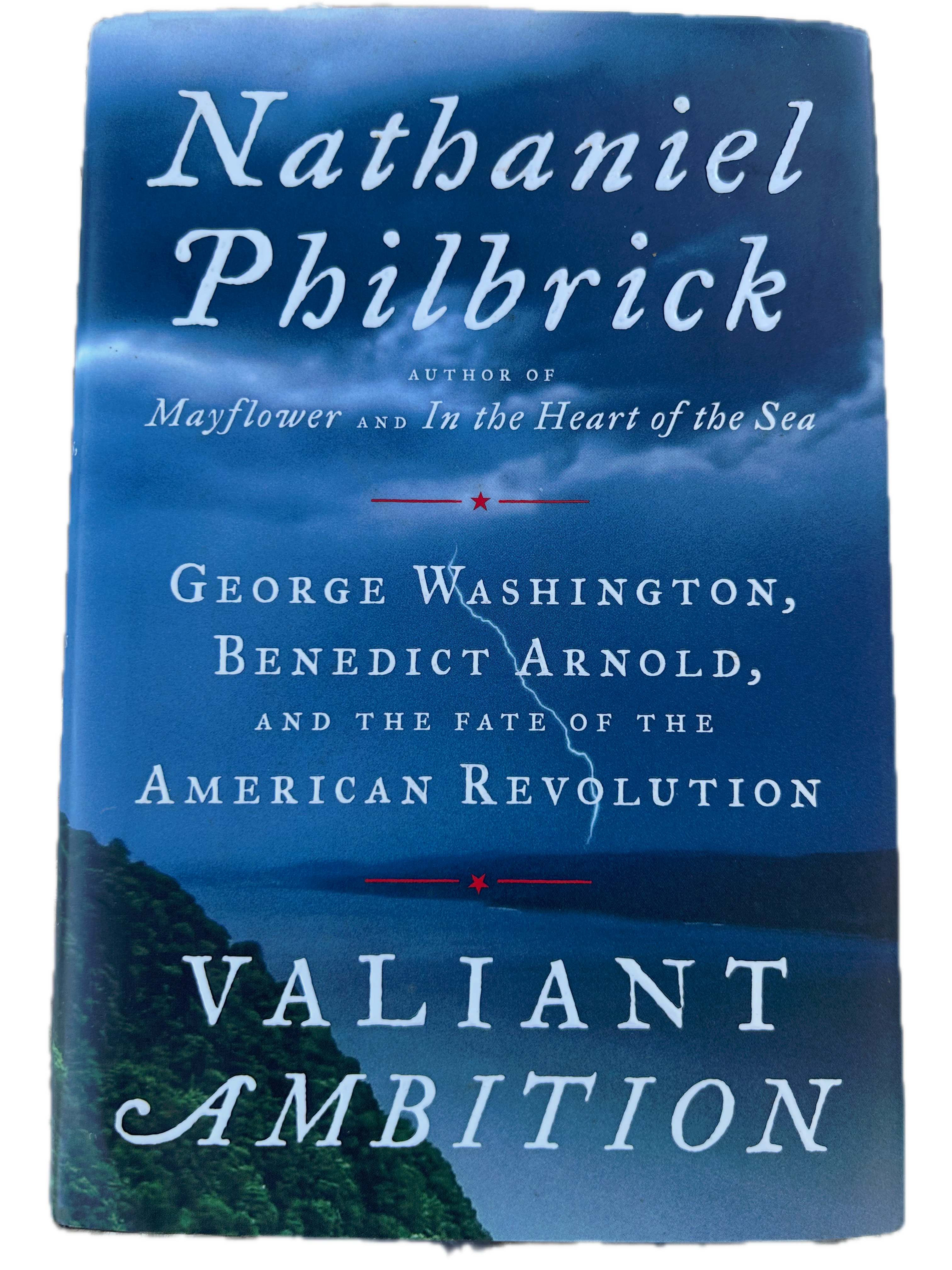
My own way to celebrate, is by reading all three of the books in Philbrick’s r trilogy: “Bunker Hill,” “Valiant Ambition,” and “The Eye of the Hurricane”, before the 250th anniversary.
I finished “Bunker Hill” on vacation this spring and am more than halfway through “Valiant Ambition,” which I can’t put it down. It has seriously cut into my gardening time.
“Valiant Ambition,” gets into the guts of the major battles in the early years of the war, focusing on the character and decisions of two key figures: General George Washington, commander of the northern Army, and Major General Benedict Arnold, who most of us learned in grade school was a traitor to the Patriot cause.
He was indeed a traitor, but Philbrick illustrates Arnold’s path from a brave and courageous officer, one of Washington’s favorite generals, to his betrayal when as the commander of West Point, he struck a deal with the British to surrender the fort to them. The plot was discovered before it could happen, and Arnold was not hanged. He managed to escape, switched sides and fought for the British during the rest of the war. He ultimately ended up in London, where he died at the age of 60.
What I’ve enjoyed about this historical series is Philbrick’s skill as a storyteller, using scads of primary research, giving the reader the feeling of being there, as he incorporates quotes from letters and journals into the story.
He lays out how messy the war was and how the political dealing, backstabbing and pettiness of Congress often hurt the Patriot cause. He allows us to see the heroes of the revolution as ordinary men, rising to extraordinary times.
The generous use of maps throughout the books added to my understanding of the text when battles were described. I was fascinated to see what Boston looked like back in those days. It was a virtual island, connected by a land bridge. Newbury Street, Copley Square and the Prudential Center, where we shop and dine and is known as the Back Bay, was in fact a watery expanse, later filled in and developed.
I can’t recommend this trilogy enough. It’s hardly light beach reading, but it is informative and entertaining.
I think it's the Declaration of Independence that will be read at St Paul's as it always used to be at the Unitarian Church on July 4 which is Independence Day